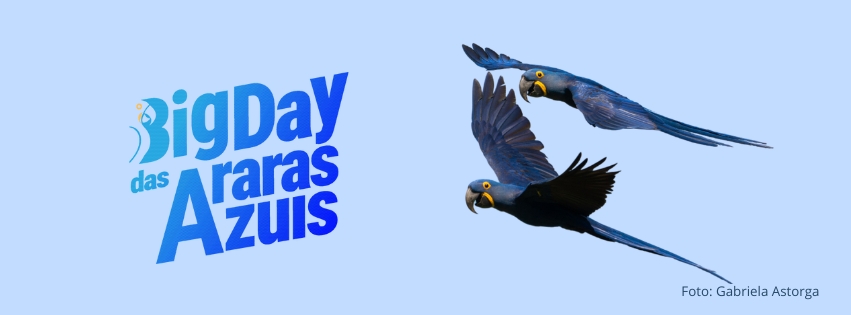
On August 16 and 17, 2024, the first BIG DAY for Hyacinth Macaws (Anodorhynchus hyacinthinus) took place, the largest mobilization effort for counting hyacinth macaws ever carried out for the species worldwide. The event brought together biologists, volunteers, birdwatchers, park rangers, partner institutions, digital platforms, companies, and local communities in three South American countries: Brazil, Bolivia, and Paraguay (see partners at the end).
In total, 1,275 sightings of the species were recorded in their natural habitat, with 897 hyacinth macaws in Brazil, 359 in Bolivia, and 19 in Paraguay, a country where they were practically extinct and are now beginning to repopulate. It is worth noting that two records, one of hyacinth macaws in Brasília and another of several macaws (we believe to be blue-and-yellow macaws) in Pauliceia, in the interior of São Paulo, were not counted because they were hand-raised hyacinth macaws that had been released.
The records were reported via the digital platforms E-bird, Google Forms, Wikiaves, Biofaces, and WhatsApp using a specific number for this action. The highest number of records was obtained first by WhatsApp, followed by Google Forms. In addition to the 1,275 hyacinth macaws, other large macaws were observed, such as red-and-green macaws, blue-and-yellow macaws, and hyacinth macaws, but these were not included in this total.
Brazil: the highest count
In Brazil, hyacinth macaw counts were spread across the Pantanal, Cerrado, and Amazon biomes in four states: Mato Grosso do Sul, Pará, Mato Grosso, and Goiás.
In Mato Grosso do Sul (MS), 27 records were obtained, totaling 409 hyacinth macaws, ensuring the state’s leadership in the national count. More than 50 people organized into teams gathered in the cities of Aquidauana, Camisão, Corumbá, Coxim, Jardim, Miranda, Nova Esperança, and Terenos, with the highest numbers of macaws sighted in the cities of Miranda (230), Aquidauana (137), and Corumbá (20). The Mamede Institute was instrumental in mobilizing birdwatchers and nature lovers throughout the state.
In the state of Pará, in Canaã dos Carajás, a total of 48 people, divided into groups over two days, involving Vale employees and the Hyacinth Macaw Project field team, made the recordings. These groups visited various locations where the species occurs, conducting a census during the day and performing simultaneous counts in the roosts at the end of the two afternoons in five locations, with the active participation of the local community. The effort resulted in 12 records and a total of 335 hyacinth macaws, in addition to the observation of other birds, involving the community and citizen science.
Ranked third nationally, Mato Grosso recorded 151 hyacinth macaws. Noteworthy is the participation of observers Roseno and Gonçalo (Pixico) from Poconé, representatives of the local community and long-time partners of the Hyacinth Macaw Project, who together recorded a total of 83 macaws, in addition to contributions from institutions such as SESC Pantanal (8 macaws) and Onçafari (26 macaws).
In Goiás (GO), the OIA Passarinhar group In Goiás (GO), the OIA Passarinhar group mobilized six members in two areas in partnership with ICMBio where the species occurs: Resex Recanto das Araras de Terra Ronca (GO) and Terra Ronca State Park (GO). The macaws were recorded only in the Resex, totaling two macaws. It should be noted that where people were counting, the absence of macaws was noted, which has important significance for the studies.
Unfortunately, there were no records in the states of Tocantins, Maranhão, Piauí, and Bahia, where we know the species also occurs.
In Bolivia, 29 people, including 13 park rangers from the San Matias Reserve, actively participated in the action, covering 23 counting points during the two days of the campaign, covering almost 100% of the species’ distribution area in that country. The result was impressive: 359 hyacinth macaws were recorded in different areas where the species occurs. Partners Mauricio Herrera (Noel Kempff Mercado Natural History Museum), Fundación CLB, and SENARP (National Service for Protected Areas) were instrumental in mobilizing society in the neighboring country. The park rangers and the community, together with CLB, were instrumental in the registrations, considering that on the 7th there was an election for President of the country and people were unable to travel long distances.
In Paraguay, where the species was considered nearly extinct in recent years, the count was conducted at five different locations. No individuals were found at one of the locations, but at the others, 19 hyacinth macaws were recorded, marking a historic reunion of great significance for conservation.
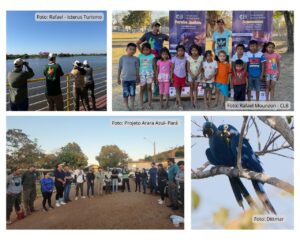
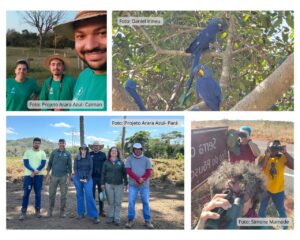
Importance of the campaign and next steps
The BIG DAY for Hyacinth Macaws demonstrated the power of citizen science and cooperation between countries for the knowledge and conservation of biodiversity. It is important to note that, even though hyacinth macaws were not sighted at the time of the count, people were able to observe biodiversity and get closer to nature by observing other species. In addition to generating updated data on the distribution of the species, the action strengthened ties between local communities, researchers, and conservation organizations.
The expectation is that, in future editions, even more people will engage in the activity, expanding the geographical coverage and the number of records. As the Hyacinth Macaw Institute team points out, “knowing where blue macaws are present is essential to ensure their protection and the future of biodiversity.”
How many hyacinth macaws are there in the wild?
That was the main question we wanted to answer, but it still remains unanswered. For Neiva Guedes, who has devoted more than three decades to studying this species, “this number of 1,275 individuals represents around 20% of the hyacinth macaws found in the wild” (Guedes et al, 2008). This species is extremely specialized in its diet and consequently limited to its habitat. It is resilient, having been here since before the discovery of the Americas, but at the same time susceptible, due to its life history, and vulnerable to several other factors such as trafficking, habitat loss and alteration, climate change, among others.
The teams from the Hyacinth Macaw Institute that carried out the facilitation and mobilization worked simultaneously in the Amazon, Pantanal, and Cerrado, regions that had the highest number of national records. However, there was a gap in records in several known locations where the species occurs, both in some sub-regions of the Pantanal and in the states of Tocantins, Maranhão, Piauí, and Bahia, which were not documented. Thus, we hope to improve the count in 2026, with the effective presence of communities in all locations where the species occurs naturally. We hope to involve more people, especially in the field, to obtain records, so that we can obtain a more realistic sample of the species today.
This year, the great result that we should undoubtedly celebrate is the mobilization of people, considered a milestone! A pioneering initiative that brought together science and community engagement. We counted on support from ordinary people in rural areas in the interior of the three countries, as well as large mobilizations in cities, with children, students, biologists, guides, and other professionals. The number of people directly and indirectly reached, mainly through social media, was surprising! On the Hyacinth Macaw Institute’s social media alone, 137,726 people were reached, with 203,292 views and 8,253 interactions, where they learned about and liked the information on the social media of the Arara Azul Institute and all the partners in this action. In a celebration of life and nature in support of biodiversity.
About the Hyacinth Macaw Institute
Conceived and led by biologist and scientist Dr. Neiva Guedes, the Hyacinth Macaw Project was launched in 1990 and now has 35 years of experience and worldwide recognition for its scientific work, which has dramatically changed the reality of the hyacinth macaw in the Pantanal.
In 2003, the Hyacinth Macaw Institute was created, a non-governmental organization that was established to legally support the Hyacinth Macaw Project. However, through its expansion, it has been developing several other projects.
Currently, the Institute operates effectively in Mato Grosso do Sul, Mato Grosso, and, more recently, in Pará, demonstrating excellent results in biodiversity conservation, with international repercussions.
To learn about all the projects developed by the organization, visit: www.institutoararaazul.org.br.
Figure 1. Supporters of the first BIG DAY for the Hyacinth Macaws
Table 1. Supporters of the first BIG DAY for the Hyacinth Macaws.
| Instituição | @ |
| ACCP | acpp.py |
| Aquasis | ongaquasis |
| Asora-PY | asoraparaguai |
| AZAB (Associação de Zoológicos e Aquários do Brasil) | azab_oficial |
| Biofaces | biofaces |
| Birding Chapada Diamantina | observação de pássaros_chapadadiamantina |
| CBL | fundação_clb |
| Empresa de consultoria | ticofiladelfo |
| Viagem de descoberta | fundtur.ms |
| Guyra Paraguai – Programa de Conservação de Espécies | pássaro.paraguai |
| ICMBio
ICMBio-Cemave |
icmbio
icmbio.cemave |
| Icterus Turismo | icterus.ecoturismo |
| IPC | ihp_pantanal_ |
| Instituto Gaia Echoes | instituto ecosdegaia |
| Instituto Mamede | institutomamede |
| Instituto Retriz | institutoretriz |
| Museu de História Natural Noel Kempff Mercado – Bolívia | museukm |
| Onçafari | oncafari |
| Parque das Aves | parque de pássaros |
| Pássaros do Planeta | planetaaves_oficial |
| Projeto Arara Azul de Lear | projetoararaazuldelear |
| SAVE Brasil | salvebrasil |
| SERNAP | sernap.oficial |
| SESC Pantanal | sesc_pantanal |
| SOS Pantanal | sospantanal |
| Terra da Gente – EPTV | terradagente |
| UFG | oia_passarinhar |
| UFT- Campus Arraias | turismo.uftarraias uftoficial |
| Vale | valenobrasil |
| Vitinho Birdwatching Tours | vitinho_birdwatchingtours |
| Wikiaves | wikiaves_oficial |
| Zoológico de SP | zoológico |

Text by: Instituto Arara Azul

